This website has moved!

Politically Me is no longer available here. To read James' blogs, please visit www.jphillips.eu

You will be automatically directed there shortly

Showing posts with label obama. Show all posts

Monday, 15 July 2013

Keep Calm! This Murder Was Legal


Seventeen months on from his death, Trayvon Martin’s family have been denied justice, as the jury declare George Zimmerman as ‘not guilty’ of second-degree murder. On the evening of February 26th 2012, Zimmerman followed Martin from his car on his own charge of Martin looking “up to no good”. Within twenty-one minutes of Zimmerman phoning the police declaring his unfounded concerns, Martin was declared dead after having been shot by the neighbourhood watch coordinator. The evidence suggests that this was a completely unprovoked attack on an innocent teenager, yet strangely, Zimmerman has been acquitted.

Despicably, there was nothing to suggest that Martin was involved in any criminal activity. In fact, it appears that Martin was returning to his home, and only began running from Zimmerman as he became aware of the fact that he was being followed. Ludicrously, according to the transcript between Zimmerman and the police dispatcher, Martin deserved the attention, because “it [was] raining and he [was] just walking around, looking about”. That hardly calls for active pursuit – when did it become a crime to walk around in the rain and use your eyes to look at things around you. The dispatcher told Zimmerman not to follow Martin, but he continued. Zimmerman was also reluctant to give his address to the dispatcher. This already screams guilt.

If the injuries that Zimmerman suffered were a result of Martin’s actions, it can only be assumed that they were in self-defence against the unwarranted pursuit and aggravation of the powerless neighbour watchman. The attack escalated quickly and resulted in the shooting of the teenager; Martin was shot within seven minutes and dead within twenty-one minutes of Zimmerman calling the non-emergency line. Zimmerman cries that he acted in self-defence, but if we are to believe that he followed Martin and acted to detain him before the police arrived, with no justification outside of supposed suspicious activity, then Trayvon is the only one who could have cried self-defence. It’s not a legitimate claim to argue that you acted in self-defence against someone else who was already acting in self-defence. You can’t claim that you acted in defence when it was you that instigated the altercation.

Some might argue that this verdict of ‘not guilty’ does not proclaim Zimmerman’s innocence, but that there was simply not enough evidence to convict him as guilty. But the call with the dispatcher, testimonies from witnesses, and no evidence to suggest that Trayvon was involved in any criminal activity at the time, only suggest that there was no legitimate motivation for Zimmerman to pursue and kill the teenager. Furthermore, Zimmerman was told not to follow Trayvon, did not have any power as a police officer and, thus, no right to use his gun in defence, and may have acted with a racist motivation - did Zimmerman see him as suspicious because he was a black male walking around? He was recorded stating “fucking punks” and “these assholes, they always get away”, implying that he discriminated against Trayvon on the basis of being part of the group that he named as “punks” and “assholes” – this group most certainly could have been based on race. This may not be just a case of murder, this may be a new case of anti-racism.

The fact of the matter is that Zimmerman shot dead an innocent male, with no real power to use such force. The police arrived just a moment later, and that one moment could have been enough to save this young male’s life. Yet, the jury declare Zimmerman as ‘not guilty’ of murder and even manslaughter, which seems ludicrous. There is no doubt here that Zimmerman killed Trayvon Martin – it is also likely that he planned the action from the moment he set his eyes on him – and that his response was not a proportionate response to the attack he alleges he was defending himself from.

As such, the string of protests in response to the verdict are justified, pronounced and internationally supported. There is real cause for concern in this case and the appeal for a further case should be backed by millions of supporters. Yet, Obama has called for calm, seemingly acknowledging the verdict as final and dismissing the distress the case has caused for people across the world.

However, if this appeal to the civil rights case is unsuccessful, Zimmerman will be unlikely to live his life as an innocent man. In the minds of many across the United States (and indeed the world), he remains a guilty man, and he will not be allowed to forget the death of the young teenager that he caused.

Wednesday, 26 June 2013

It’s Time to Tackle Climate Change


Barack Obama yesterday announced a wide-range of reforms to tackle climate change to make himself the most committed president to challenging growing ecological problems. From cutting carbon emissions to developing renewable energy, the demands from the President demonstrate an acceptance that climate change is a real problem that needs to be tackled. However, is his speech simply a demonstration of rhetoric, or is there something to look forward to?

The President of the United States released his plans to the public yesterday via a document and a speech at Georgetown University, and he makes some very promising points. His commitment to reducing carbon pollution in America, following on from mercury and arsenic, is a particularly important step, making the world a safer and more sustainable place for generations beyond us and the wider animal kingdom and their habitats. Furthermore, by doing this, he is committing to developing more renewable energies, which is not only good for the environment, but it also increases employment opportunities and helps to strengthen the economy. Obama positively suggests that this can be carried out alongside keeping the economy growing.

He also addressed the problem of natural disasters that climate change has caused, by announcing plans to protect people from the adverse effects of severe weather. This is perhaps where the UK can learn a lesson. With flooding increasing in recent years, it is certain that we need to tackle the problem at its source, but also increase flood defences, strengthen bridges and protect people’s homes to ensure that people are not made homeless and lose their possessions over and over again.

However, despite Obama’s great intentions, his announcements fall short. His continued commitment to nuclear energy and fracking allow cause for great concern. Both of these energy sources are dangerous to the population, with scientists proving that the latter has been linked to rare earthquakes in the UK. It also relies on a limited amount of shale gas resources and involves the destruction of habitats and the environment in the search and extraction of it. In addition to these concerns, he neglected to make any indication as to his decision on the Keystone tar sands pipeline, only stating that climate implications would be considered before making his decision. He also failed to mention any way of combating those who emit too much carbon and pollution, such as a tax or a penalty charge. Whilst the capitalist system allows for companies to exploit the environment with no consequences, we are unlikely to see any real change from such big industries.

Unfortunately for him and environmentalists, the US political system works in such a way that the President can’t just get what he demands and anything Obama wishes to push through must first go through Congress. So, was his speech yesterday another display of rhetoric, or a real commitment to making sure the progress starts during his administration? After all, we’ve seen his previous promises about Guantanamo Bay and no real action has been made on that front.

Nevertheless, the announcements made by the President push thought on climate change in the right direction; the problem needs to be addressed and tackled before it is too late. It is hopefully a step that his citizens will climb on board with, and one that nations around the world will learn from. To tackle climate change, everyone needs to be in it together.

Wednesday, 5 June 2013

Syria; the Unwinnable War

(Warning: this article discusses potentially traumatising and upsetting topics. Furthermore, the article will be using graphic and distressing images. Please do not read on if you feel you will be negatively affected by this.) 
 
The Syrian Civil War has progressed into one that is hard to find a solution for. After two years with the world looking on, the battle between the Assad Regime and the Free Syrian Army is just a massive bloodbath; the normality of war has taken hold and it appears that a concept of right and wrong has been forgotten. The war is not unwinnable because it will not end, but because no matter which force is successful, there is nothing redeeming about their actions and, thus, no joy or reason to celebrate. Truly awful atrocities have taken place in the country and it is too late for them to be taken back.

Hard as it may seem, morality can exist in war. The basic principles of just war theory allow us to gain an idea of what this may look like: to be undertaken in a last resort and all actions a proportionate response to the initial provocation. I’m sure we can all agree that there are certain acts, such as rape and torture, that are abominable regardless of the situation. Not even war can justify some actions.

Yesterday, the French Government confirmed that the chemical weapon, Sarin, a nerve agent, has been used by the Syrian Government during the, now, 27 month conflict. The weapon causes the nerves in our body to act differently, inevitably resulting in our bodily deterioration (The Atlantic provides a comprehensive understanding here). The unnecessary force against the protestors in the Arab Spring was detrimental far beyond what anyone expected. A peaceful and legitimate protest has become an easily avoidable massacre of 120,000 civilians, some of those from neighbouring countries or drafted in forces. The continued use of Government forces, large-scale weapons and, now, use of the chemical weapons stock show how mindless the Government are in the slaughter of their own citizens, and anyone else caught up in the process.

Baker (in the May 23rd issue of Time) discusses, however, the true horrors of the Free Syrian Army (FSA) displayed in a video proudly uploaded to YouTube. The video, below, should be watched at your own peril. The man in the video, whose war name is Abu Sakkar (but whose real name is Khalid al-Hamad), appears to have killed a soldier and seems adamant on disgracing the pro-regime male further by cutting the heart and a lung from the body, proclaiming “I swear we will eat from your hearts and livers, you dogs of Bashar” and then raising one of the organs to his mouth and eating from it.


This one video, arguably, represents an extreme version of the mentality of soldiers in this war; we can only hope that this act of cannibalism is an isolated incident and is not repeated throughout the ranks. However, what can be confirmed is similarly horrific actions (if you ignore that murder in itself is a horrific action). Public executions, sexual assaults and the torture of children have been prominent throughout the prolonged conflict.

Furthermore, Western Intervention is looking increasingly unlikely, particularly from the USA; memories and lessons from the Iraq and Afghanistan wars as well as an inability to back a side. The “War on Terror” has shown that even our own soldiers, who we praise and call “heroes” are not clear of blood on their hands. Bradley Manning, currently on trial in America for leaking US military documents to Wikileaks, provided the below video to show how US soldiers were so eager to play with their toy guns and got frustrated when control took too long to give permission. In the video, we see that soldiers mistake cameras for weapons and even RPGs and decline faster, more hygienic and more successful treatment for two injured children. Those “bastards”, as we hear them called, were shot down during their innocent everyday lives by bloodthirsty soldiers.


But for none to get involved is to not challenge the distressing events of the war and to allow them to continue with no consequences, disregarding the many lives that are being ruined. However, even if, hypothetically, Western nations improved their code of conduct and rules of engagement for war, it would be difficult for them to choose which side of the battle to fight alongside of. To fight on the side of pro-regime supporters would be to justify the systematic and institutionalised murders of its own citizens and to help in the process; but to fight alongside the FSA would be to condemn the Government, help with the murders of citizens and to install the leadership of those who have committed such immoral actions, essentially legitimising them. Neither of these are attractive or moral in themselves, so a third option must be discovered, but this is harder than it may seem and requires multilateral agreement (which itself is hard to find.)

However, as the war continues to spill into the neighbouring countries of Turkey, Israel and Lebanon, this difficult decision looks increasingly like it will need to be made. War must be avoided at all costs, and intervention does not necessarily mean of the military sort. Large-scale mediation can, if properly implemented, work. But, regardless of this fact, the conflict needs to be ended as quickly and with as few lives lost in the process as possible. However, with continued criticisms of existing conflicts in the Middle-East and the atrocities committed by both sides of the war, the war appears simply unwinnable.

Monday, 4 March 2013

“The Sworn Enemy”

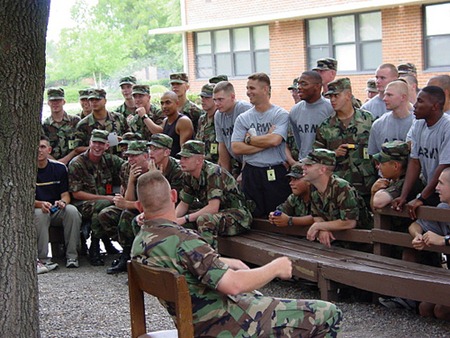
US Army Life in Fort Gordon, Georgia Image by Parker Knight 

Tell me, when I ask you to think of two nations of the world who are notoriously known for their enmity, what names come to your mind? Israel and Palestine? USA and Russia? USA and North Korea? It is the latter that has come particularly into the limelight most recently yet it is quite a strange situation. If we consider them to be archenemies, it is questionable as to how their long-term hostility has not resisted a manifestation into direct conflict. So, what is it that’s stopped a usually arms-friendly nation from sending their warships over and demolishing the republic?

Their history spans a relatively long period in the timeframe of American history with relations being negative from as early as the mid-nineteenth century, before the nation split into the North and South regions, when the region closed its borders to Western trade and attacked ships sent to negotiate treaties. These relations worsened during the Cold and Korean wars and on creation of the Democratic People’s Republic of Korea, the United States refused to and continue to refuse to grant diplomatic recognition to the country.

As we look over the last century, we can see the US comfortably waging war in Vietnam, Afghanistan, Iraq and, most recently, intervening in Libya. It would appear that wherever the US saw a threat, they would pre-emptively act on it and reduce the threat considerably. It is debatable, but perhaps they have stopped short of colonisation and imperialism whilst “democratising” and “stabilising” their battlegrounds. If they’re not waging a war physically, it’s almost certainly some form of psychological and propaganda warfare and a constant assertion of US dominance and power throughout the world – even if they wanted to, no country is left believing the US weak, including the UK. However, it appears the same cannot be said of North Korea.

Recent tests of satellites, long-range missiles and nuclear weaponry in the North Korean region has heightened tensions across the world. Yet, in vast contrast to the US intervention in Afghanistan which was just under a month after the 9/11 attacks, any direct action from the United States is restrained. Perhaps it is the worry of response from the allies, China and Russia in particular. Yet, this is unconvincing; the lack of support from allies did not stop them in their advancement into Iraq in 2003. Perhaps they have learned their lesson from the global criticism of this attack, and this is the reason they have also not intervened to stabilise Syria.

Yet, when Kim Jong-Un is blatantly threatening the United States with technology that could be used against Hawaii immediately, and an invasion that the American people are more likely to approve of than Iraq, it is bizarre that the US administration are able to hold so much restraint on their actions; it is not something they are so well known for. Perhaps we are seeing a change in attitude under Obama, even though his own home turf is supposedly directly at threat, with the whole Western coast in sights within three years.

Is this a continuation of the cold war that emerged between the United States and Korea in the mid-twentieth century, or is this a new cold war? Whatever it is, it is definitely a case of both countries preparing to flex their muscles and show off about their fabulous warheads that they could launch at any time, and maybe something we should be worrying about. Perhaps we’ve already responded with a secret deployment of troops in the South region who should be worried about their “final destruction”.

Sunday, 11 November 2012

Choosing a Leader

5758106479_cf4ca592f3

Image by Cabinet Office on Flickr

It’s a funny thing choosing a leader for your country and essentially choosing someone to place your trust in to for a prolonged amount of time, with no real ability to recall your vote. It’s a big decision we must make, and most often one people end up regretting by the time the chosen one has finished dismantling the hard work that someone else has put in.

In the wake of Obama’s victory and re-election in the United States, it’s a little overlooked that we are now halfway through our Condemned Government (of course, unless by some stroke of luck, Parliament is closed) and that means we can officially count the days until we are certain their mandate will end. That wonderful time at which we can hold Clegg and Cameron to account and completely humiliate them with what will probably be a resounding Labour win is now closer than the time we voted them in (although this is arguable in itself.) The end is nearer than the beginning, although not exactly nigh yet.

It’s no secret that all of the parties are already planning their election campaigns for 2015, deciding who will lead their campaigns and what their manifestos and key policies will be, making predictions for what will happen over the next few years and be high on the agenda in 2015, so I’m going to make some of my own:

  • Nick Clegg will be replaced as leader by Vince Cable either for the election or as a result of the election
  • The PCC elections will show to have little support and little turnout and the decision will be reversed or reduced
  • The Labour Party will not have tuition fees as a key policy or will only reduce fees by a small amount
  • UKIP and the Green Party will see a small rise in support
  • Labour will win an overwhelming majority, but still not match Blair’s 2001 majority. Lib Dems will lose a large number of seats and Nick Clegg will not win the Sheffield seat.
  • The UK will enter another recession in 2013.
  • Another European country using the Euro will collapse.
  • There will be further military intervention in the Middle East, Syria or the Faulklands.

Some may seem far-fetched, and some might seem plain obvious. I think all of these are highly possible, but let’s see how the next two and a half years pan out, shall we?

Thursday, 2 August 2012

What's next for Syria?

The Syrian crisis continues to worsen and any improvement to the situation seems an all too distant possibility. The announcement of the UN's special envoy to Syria, Kofi Annan's resignation from the role highlights the difficulty of the task; and aside from that, revelations from Obama's administration and talks between Russia's Putin and David Cameron  clearly demonstrate the absolute lack of international unity.

But what is the real heart of the problem? Is it a lack of unity between all members of the United Nations, with China and Russia vetoing any proposed action on Assad's regime, or is it the fact that neither the regime or the 'rebels' are adhering to the six-point plan that Annan attempted to implement? Every side blames the other, so no clarity is apparent. Regardless, the crisis is infuriating, and despite it's similarities to the Libyan uprising last year, it is also very different. Cynics might say it's to do with oil, others to say with key alliances; either way, there are civilians being killed left, right and centre here, and it's not something that should occur no matter the situation.

The situation is vastly different to Libya for a number of reasons; essentially, the sides of the oppositions and the length of time this conflict has spanned define the sensitivity of the situation. Comparatively, Libya appeared to have an almost everyone-against-Gaddafi situation, where the majority of citizens were in favour of his deposition, whereas within Syria, there is an obvious divide of opinion, and to favour one side over another would be to ignore the rights and opinions of a large sector of society, regardless of what the rest of the country and, indeed, the world thinks. Secondly, the conflict in Libya lasted only a couple of months before there was international intervention, whereas this conflict has lasted over a year now. The common opinion now is that Syria is militarised; citizens are used to conflict and there is danger for any person within the country. To arm the citizens would not simply result in the overthrow of the Government, but rather in the massacre of a vast number of citizens who disagree with the most armed side. These two points put us in a very difficult situation.

What's the correct way forward? I'm no expert on international relations, and I would hate to advocate war in any form, but it's obvious that some kind of action needs to be taken to depose Assad, or the country needs to be sorted and split, like with Sudan. But first, diplomacy needs to ensure that there is peaceful transition and implementation of whatever strategy is agreed upon. Unfortunately, diplomacy appears to be the first hurdle that cannot be overcome, forcing Annan's resignation today. And Obama appears to have decided that also, signing the document for approval in helping the rebels a few months ago, in a covert operation, just falling short of agreeing to arm them. We are yet to see the backlash on this, and a resolution that China and Russia agree appears too distant.

The strangest part of the situation; Syria have still been able to enter a team into the London 2012 Olympics, and they are competing alongside international athletes peacefully. How can a country that is killing its own citizens be able to peacefully enter an international sports competition is beyond me, but apparently it's possible.